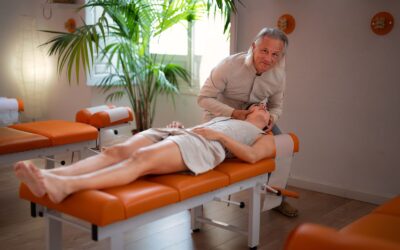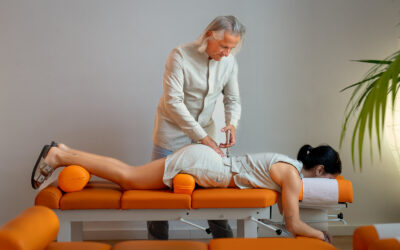


In short: a physiotherapist works to restore movement and function throughout the body using physical means, such as exercise or manual therapy [2][19]; a chiropractor focuses on the spine (neck, mid back and lower back), and the main tool is the adjustment, especially of vertebral subluxations (vertebrae that have lost their normal movement) and of the other joints of the body [7]. For back or neck pain, clinical guidelines include tools from both professions [12][13].
At Tonovital you do not have to choose: José De San Juan Guerrero is a Doctor of Chiropractic, graduate of Sherman College, USA, and a registered physiotherapist in Spain (no. 5960) [22][23].
The essentials at a glance
| Physiotherapist | Chiropractor | |
|---|---|---|
| Focus | Movement and function of the whole body [19] | The spine and the other joints [7] |
| Tools | Physical means: exercise, manual therapy, electrotherapy [2][19] | Adjustment of the spine and the extremities [7] |
| Training | In Spain, a 240-credit university degree (4 years) [1] | In the USA, a prior university degree + Doctor of Chiropractic [7][9] |
| In Spain | Regulated health profession [2], with compulsory registration [3] | Not regulated as a profession of its own in Spain: it is not on the list of health professions in Law 44/2003, so there is no official Spanish chiropractic degree [2] |
What does a physiotherapist do?
According to the profession’s world body, physiotherapists develop, maintain and restore people’s maximum movement and functional ability, at any stage of life, when these are threatened by ageing, injury or disease [19]. Spanish law gives them the care specific to their discipline through physical means and agents, for recovery, rehabilitation and prevention [2].
What does a chiropractor do?
The standards that every accredited chiropractic school in the USA must meet require chiropractors to identify subluxations or dysfunctions of the spine and other joints, decide when an adjustment is indicated, and deliver it [7]. Clinical guidelines include spinal adjustment among the treatment options: the American College of Physicians guideline for low back pain [12] and the 2016 guideline for neck pain [13], the latter together with exercise and other care.
Are the techniques really that different?
Less than you might think. The quick, short movement on a joint that chiropractors call an adjustment is called manipulation, or a high-velocity low-amplitude technique, in physiotherapy. In Spain, the order that sets the content of the physiotherapy degree includes joint manipulative therapies and osteopathy [1], but it does not set hours, so each university decides how much time to give them; in some programmes the course focuses on joint mobilisation [24]. In-depth training comes at postgraduate level: master’s degrees in orthopaedic manual physiotherapy with international standards [14][25], or master’s degrees in osteopathy, which in Spain are university-specific qualifications [26]. In the Doctor of Chiropractic programme, by contrast, the adjustment is one of the core competencies the accrediting agency requires of every school [7].
How is each one trained?
- Physiotherapy in Spain: a 240-credit European degree, that is, 4 years [1], and compulsory registration with a professional college to practise [3].
- Chiropractic in the USA: to enter the programme, the rule of the agency that accredits every school (CCE, recognised by the US Department of Education) is a completed university degree; students may also be admitted with 3 years of university (90 credits) and a good grade average [7]. Then comes the Doctor of Chiropractic programme: at Sherman College, where José trained, it is 14 consecutive quarters with 4,956 hours of classes, laboratory and clinic [9]. To practise, graduates must pass the national board exams [8] and obtain a state licence [7].
- Chiropractic in Spain: there is no official Spanish qualification, because the profession is not included in the law on health professions [2]. The European body that accredits chiropractic education (ECCE) has accredited two programmes in Spain: the Barcelona College of Chiropractic, since 2017, and the McTimoney College in Madrid, since 2024 [10].
- For comparison: medicine in the European Union requires at least 5 years and 5,500 hours [4].
What does US chiropractic training teach about diagnosis and referral?
In the United States, chiropractors are direct-access professionals: patients can see them without a referral from a doctor [7]. That is why the standards every accredited school must meet (CCE, January 2025 edition) require students to be able to [7]:
- take a case history with differential diagnosis in mind;
- examine the body by regions and systems, not just the spine;
- order and interpret laboratory tests, imaging and other tests;
- decide when emergency care is needed, refer to another professional or work alongside them.
The national exam required to practise (NBCE, Part II) gives 11% to interpreting laboratory tests, including urine and blood, and 17% to diagnostic imaging, including MRI [8]. Sherman College has courses in laboratory diagnosis, physical examination and radiology report writing [9].
At Tonovital we do not make medical diagnoses. In Spain, medical diagnosis belongs to doctors [2], so that is your doctor’s job. What remains is the training to recognise when a pain does not belong in our clinic and to tell you where to go. If you bring reports or scans you already have, we study them to understand your case better. And if a test is needed, where appropriate, we will recommend it.
And the doctor?
Spanish law gives doctors the diagnosis, treatment and prevention of disease [2]. For low back pain, the American College of Physicians guideline recommends starting with non-drug treatments: heat, massage, acupuncture or spinal adjustment when the pain is recent, and exercise and other therapies when it has become chronic [12]. What we do at Tonovital does not replace your doctor: it works alongside.
Is chiropractic regulated in Spain?
Not as a separate profession. In countries such as the USA [7][8], Canada [17], the United Kingdom [15], Switzerland [16] or Australia [18], chiropractic is a profession regulated by law. In Spain, the law on health professions does not include it [2], but it does include physiotherapy [2]. José practises as a registered physiotherapist, with a health qualification recognised in Spain.
The Spanish tax authority, on the other hand, does treat the services of a chiropractor who graduated from an accredited school as healthcare for VAT purposes. Spanish VAT law exempts care provided to individuals by medical or health professionals [21]. In 2019 the Court of Justice of the European Union made clear that this exemption does not depend on the profession being regulated as a health profession in the country, but on the service being healthcare and the professional having the right qualifications [5]. Since 2021, the tax authority applies the exemption to diagnosis, prevention and treatment by anyone holding a degree from a school accredited by one of the councils that make up the Councils on Chiropractic Education International (CCEI), such as the US CCE or the European ECCE [6][11]. That is for tax purposes only: it does not make chiropractic a health profession in Spain.
Who should you see for back pain?
More than the title of the person treating you, ask yourself:
- Do they listen and assess you calmly?
- Do they explain what is going on in words you understand?
- Do they propose a plan with clear signs of progress?
- Do they tell you if your problem is not for their clinic, and where to go?
What if both are in the same clinic?
With both trainings, the stiff joint can be worked on with an adjustment and the muscles around it with exercise, at the same time. Exercise, alone or with education, is what has been shown to prevent new episodes of low back pain [20]. And you do not have to go from one place to another or repeat your story.
At your first visit we assess your case and tell you whether it is for us. If it is not, we tell you that same day and where to go. See what your first visit in English looks like or message us on WhatsApp.
Frequently asked questions
Is a chiropractor the same as a physiotherapist?
No. Physiotherapy covers movement and function of the whole body [19]; chiropractic focuses on the spine and the adjustment [7].
Is chiropractic a specialty of physiotherapy?
No. They are different trainings, with different accrediting bodies [7][10][14]. In Spain, only physiotherapy is a regulated health profession [2].
Do I need a doctor’s referral?
Not to come to Tonovital: you can book directly. Here we explain it with the laws that apply.
Book your first visit · WhatsApp in English: +34 629 245 594 · English-speaking chiropractor in central Málaga · C/ Córdoba 6 · how to find us
Esta página también está disponible en español: Diferencia entre fisioterapeuta y quiropráctico.
This clinic works with musculoskeletal problems of the spine and joints. We do not diagnose or treat systemic, respiratory, autoimmune, metabolic or neurological diseases, and we do not replace treatment prescribed by your doctor. If you have a diagnosis of that kind, your specialist is the one who manages it.
Sources
- Order CIN/2135/2008 (Spanish Official Gazette, BOE): requirements for the physiotherapy degree, 240 credits
- Law 44/2003 on the organisation of health professions (BOE): articles 2, 6 and 7
- Law 2/1974 on Professional Associations (BOE), article 3.2
- Directive 2013/55/EU amending Directive 2005/36/EC: medicine, at least 5 years and 5,500 hours
- Court of Justice of the European Union, judgment of 27 June 2019, case C-597/17
- Spanish Directorate General for Taxation, binding ruling V0366-21 (also V0596-21)
- Council on Chiropractic Education (CCE): Accreditation Standards, January 2025
- National Board of Chiropractic Examiners (NBCE): Part II test plan
- Sherman College of Chiropractic: 14 quarters and 4,956 hours · 2025 curriculum guide
- European Council on Chiropractic Education (ECCE): accredited programmes
- Monograph «VAT for osteopaths and chiropractors» (2022, in Spanish): the judgment and the tax rulings
- Qaseem A, et al. Noninvasive treatments for low back pain: a clinical practice guideline from the American College of Physicians. Ann Intern Med. 2017
- Bussières AE, et al. The treatment of neck pain-associated disorders and whiplash-associated disorders: a clinical practice guideline. J Manipulative Physiol Ther. 2016
- International Federation of Orthopaedic Manipulative Physical Therapists (IFOMPT): educational standards
- United Kingdom: Chiropractors Act 1994
- Switzerland: Federal Act on the University Medical Professions (MedBG)
- Canada (Ontario): Chiropractic Act, 1991
- Australia: Chiropractic Board of Australia
- World Physiotherapy: what is physiotherapy
- Steffens D, et al. Prevention of low back pain: a systematic review and meta-analysis. JAMA Intern Med. 2016
- Spanish VAT Law 37/1992 (BOE), article 20.One.3
- Sherman College of Chiropractic: alumni directory, Dr. José De San Juan Guerrero
- General Council of Physiotherapists of Spain: register of members
- University of Murcia: course guide, specific physiotherapy methods (musculoskeletal), 2020-21
- Universitat Internacional de Catalunya: official master’s degree in Orthopaedic Manual Physiotherapy, recognised by IFOMPT
- University of Zaragoza: university-specific master’s in Structural Osteopathy
Reviewed by José De San Juan Guerrero, Doctor of Chiropractic, graduate of Sherman College, USA, and registered physiotherapist (Andalusia, no. 5960). Last reviewed: .