

Someone has told you that you have a pinched nerve in your lower back, or that is simply how it feels. It is a useful everyday phrase, but it is not a diagnosis, and it can mean quite different things. If you live in Málaga or are here for a while and would rather explain it in English, this page tells you what we look at, what you can do in the meantime and when it is a matter for your doctor.
In short
- “Pinched nerve” is not a diagnosis. Leg pain from an irritated nerve, a herniated or bulging disc and locked facet joints can all get called that.
- Your scan does not always explain your pain: these findings are common in people with no pain at all.
- Losing control of your bladder or bowels, numbness in the saddle area or a leg that is getting weaker are reasons to go to A&E.
- At your first visit we explain what we find before doing anything. If it is not for this clinic, we tell you that same day.
What does a pinched nerve in the lower back mean?
People usually mean one of three things. The first is a nerve root that is irritated or compressed, with pain running down the leg, sometimes with tingling. Doctors call this radiculopathy, and it is often known as sciatica. The second is a herniated or bulging disc, which may or may not touch a nerve: if your scan shows one, see our page on herniated discs. The third is locked facet joints, the small joints linking one vertebra to the next, for example at L5-S1: you bend or twist, something seems to catch and your back goes stiff, often with no pain down the leg. It can feel like ordinary low back pain.
If you have had a scan in Spain, your report may also say “pinzamiento”, for example “pinzamiento L5-S1”. That usually describes a disc that has lost height, not the reason it hurts. At that level there can also be locked facet joints, a bulge or a herniation, which is why we look at it together with your examination.
Does my scan explain my pain?
Not necessarily. A review of studies in people without back pain found disc degeneration in 37% of 20-year-olds and 96% of 80-year-olds. The authors conclude that many of these findings are part of normal ageing and have to be read alongside what is happening to the person.
That does not mean your pain is not real. It means a report alone is not enough to decide what to do.
What do we work on?
- Low back and buttock pain that comes with an irritated nerve, once warning signs have been ruled out.
- Stiffness in the lower back and pelvis, which changes how load is shared.
- Locked facet joints after bending or twisting.
- Buttock and hip muscles that have been guarding for a while.
- Everyday posture and movement: how you sit, bend and lift.
What happens at the first visit?
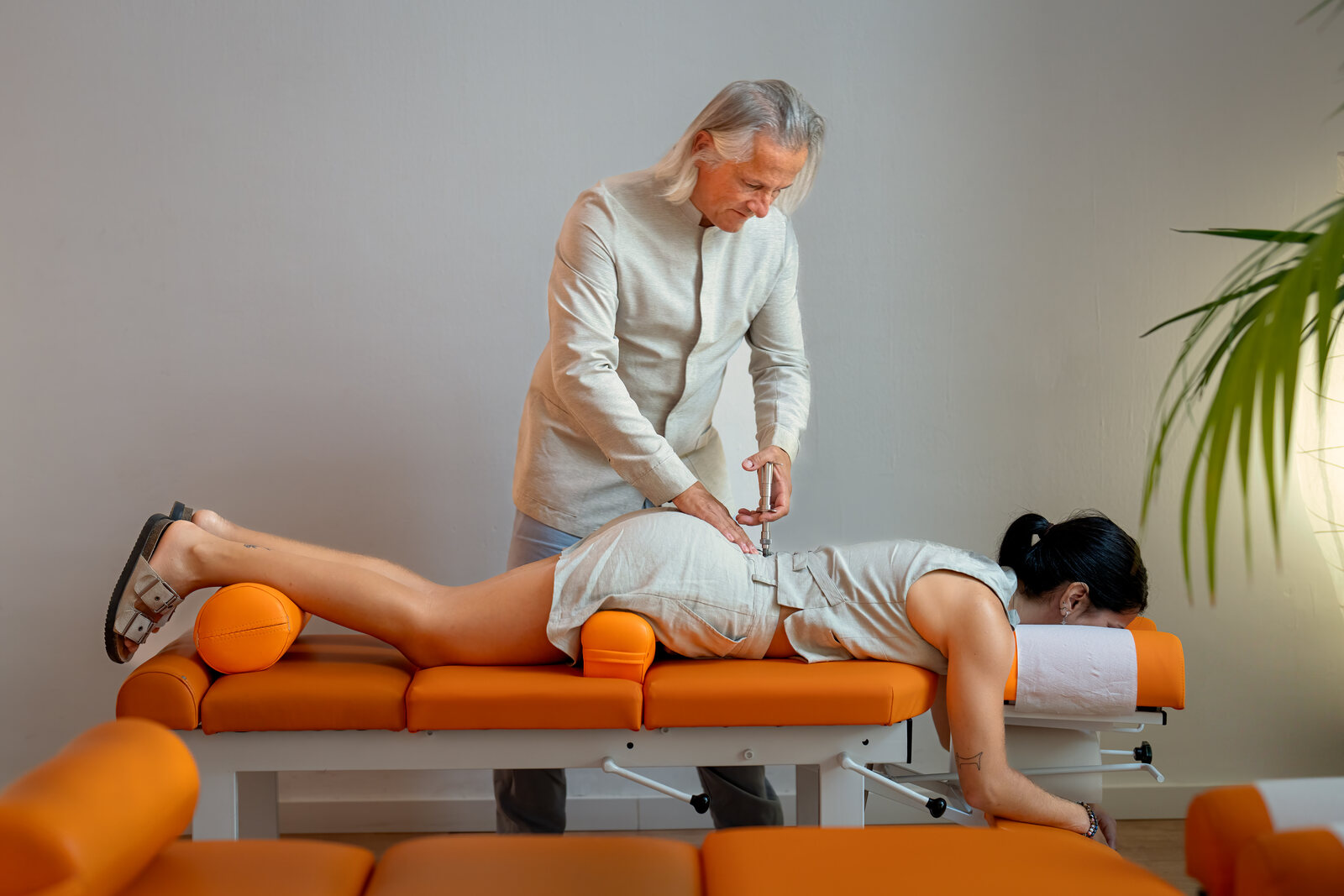
The first visit takes about half an hour, in English, and is there to work out which kind of “pinched nerve” we are talking about. We listen first: when it started, how far down the pain goes and what you have been told so far. Then comes the examination and the postural analysis. Bring any scans and reports you have.
We explain what we find before starting any treatment. If there are no contraindications, treatment can start that same day.
On the research: Danish national guidelines for recent low back pain and radiculopathy suggest, if treatment is needed, patient education, supervised exercise and manual therapy, based on low to moderate quality evidence. The references are at the end of this page.
What can I do in the meantime?
Stay active within what your pain allows. Clinical guidelines agree on information and physical activity, and advise staying active rather than resting in bed.
Change position often. If you have been sitting for a long time, get up and walk a little. When lifting, keep the weight close and avoid twisting at the same time.
If walking makes you stop, and sitting or leaning forward eases it, mention it to your doctor: in older people it can point to lumbar spinal stenosis, which is something else.
None of this replaces what your doctor has told you.
What do we not do at this clinic?
We do not promise to “release” a nerve or to restore a disc. An adjustment does not change what your scan shows, and we will not sell it to you as if it did.
We do not replace your doctor or change your medication, and we do not force a back that will not take the movement.
When should I see a doctor instead?
Go to A&E or see your doctor as soon as possible if you notice:
- Loss of control of your bladder or bowels.
- Numbness in the area you would rest on a saddle.
- Weakness in your leg or foot that is getting worse from one day to the next.
- Pain in both legs at once.
- Fever, unexplained weight loss or a history of cancer along with your back pain.
- Severe pain after a blow, a fall or an accident.
Frequently asked questions
Is a pinched nerve the same as a herniated disc?
Not always. A herniated or bulging disc is a specific finding, and it may or may not irritate a nerve. “Pinched nerve” is a more general phrase: a disc can be behind it, but so can locked facet joints.
Do I need an MRI before coming?
No. Clinical guidelines do not recommend one routinely. If you already have one, bring it. If we think you need one, we will tell you so your doctor can decide.
Can an adjustment release the nerve?
We cannot promise that. The aim is to improve movement and load in the area, and we will tell you frankly if it makes sense in your case.
Does it have to crack?
No. We can also use an instrument, which never makes that sound. More on whether an adjustment hurts and why it cracks.
Do I need a referral?
No. But if you have reports or scans, bring them.
Book your first visit · Chiropractor in central Málaga, in English · C/ Córdoba 6 · +34 629 245 594 · WhatsApp
This page is also available in Spanish: Pinched nerve in the lower back in Málaga, in Spanish.
This clinic works on musculoskeletal complaints of the spine and joints. We do not diagnose or treat systemic, respiratory, autoimmune, metabolic or neurological disease, and we do not replace prescribed medical treatment. If you have a diagnosis of that kind, your specialist is the one who manages it.
Reviewed by José De San Juan Guerrero, Doctor of Chiropractic, graduate of Sherman College, USA, and registered physiotherapist (Andalusia, no. 5960). Last reviewed: .
References
- Khorami AK, et al. Recommendations for Diagnosis and Treatment of Lumbosacral Radicular Pain: A Systematic Review of Clinical Practice Guidelines. Journal of Clinical Medicine. 2021. PubMed
- Stochkendahl MJ, et al. National Clinical Guidelines for non-surgical treatment of patients with recent onset low back pain or lumbar radiculopathy. European Spine Journal. 2018. PubMed
- Brinjikji W, et al. Systematic literature review of imaging features of spinal degeneration in asymptomatic populations. American Journal of Neuroradiology. 2015. PubMed
- Katz JN, et al. Diagnosis and Management of Lumbar Spinal Stenosis: A Review. JAMA. 2022. PubMed
- Finucane LM, et al. International Framework for Red Flags for Potential Serious Spinal Pathologies. Journal of Orthopaedic & Sports Physical Therapy. 2020. PubMed