

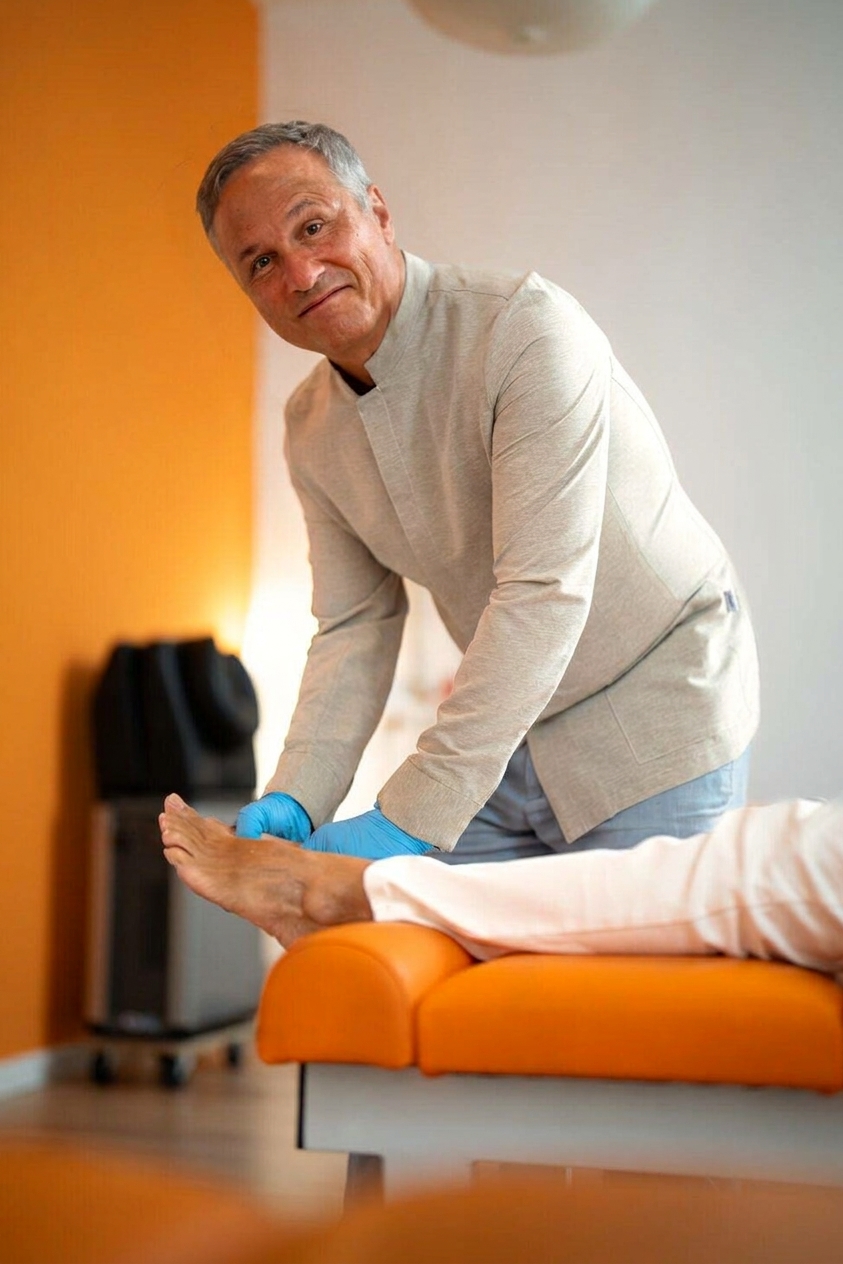
Move freely. Train without that nagging stiffness. That niggle that keeps coming back to the same spot after training? A stiff lower back the day after a padel match? If you are looking for a chiropractor for athletes in Málaga, come in and we will see how we can help.
Here is what we check in an athlete, what the research really says about chiropractic and sports performance, and when it is better to see a doctor first.
In short
- We check how your spine, pelvis and joints move, and where the same problem keeps coming back.
- Studies do not show that an adjustment makes an athlete without symptoms perform better. What we aim for is to get back the movement you have lost.
- Back pain is very common in sport: about half of athletes have had it in the last year.
- You see José De San Juan Guerrero, Doctor of Chiropractic (Sherman College, USA) and registered physiotherapist (licence 5960), with more than 25 years in practice. The whole visit can be in English.
What does a chiropractor do with an athlete?
We check how you move and work on what has become stiff or is compensating. We start with your sport: how many days you train, which movement you repeat, whether you have increased your load recently and where the problem keeps coming back. Then we examine your spine, pelvis, hips and shoulders, and run a computerised postural analysis. That tells us where to apply a specific spinal adjustment, and we explain what we see before starting any treatment.
Does chiropractic improve sports performance?
There is no evidence that an adjustment will make you run faster or jump higher if you have no symptoms. A 2019 review pooled the 20 most reliable studies in healthy adults, and most found no improvement in performance tests. Some saw more mobility straight after the adjustment, but it is not known how much that change matters or how long it lasts [1]. An earlier review, also written at a chiropractic college, reached the same conclusion: there is not enough evidence that chiropractic treatment directly improves sports performance [5]. So we will not promise you better times. What does make sense is this: if a stiff area or a recurring problem is limiting your movement, we work on it so you can train and compete moving better.
How does it help your body work better?
It helps each area do its share of the movement. When one part of the spine or pelvis stiffens up, another has to move more to make up for it, and that is often where repeated strain shows up. A specific spinal adjustment aims to give movement back to the area that has lost it, so the rest does not have to work for it. The body has its own capacity to regulate itself; our job is to remove what gets in the way of movement. Our field is the spine, joints and muscles: we make no promises about organs or general health.
Sound familiar?
- You run, and from around kilometre 8 your hip starts to bother you.
- You play padel, and the day after a match your lower back feels loaded.
- You ride, and on long rides your neck stiffens up.
If you recognise yourself in any of these, that is exactly what we look at. Our aim at every visit is that you leave moving better than when you came in.
Are there chiropractors in competitive sport?
Yes, especially in the United States, where chiropractic is a regulated health profession. In a survey of NFL athletic trainers, 31% of teams had a chiropractor on their medical staff, and 77% of trainers had referred a player to a chiropractor, mostly for low back pain. The figure is from 2002, the latest published [6]. Closer to home, at the 2019 World Sport Games in Catalonia, Spain, 406 of the 2,566 participants asked for treatment from the chiropractors of the international federation of sports chiropractic (FICS). The areas treated most were the shoulder, neck, knee and back. Participants reported less pain, but with no comparison group it is not possible to know how much was due to the treatment [7].
Which problems do we see most in athletes?
Mostly back, neck and hip pain that keeps coming back to the same place. It is very common: an analysis of 86 studies with more than 30,000 athletes estimated that around half had had low back pain in the last year. The factors that came up most often were a previous episode, high training volume, sudden increases in load and many years in the same sport [2]. The area under most strain changes with the sport:
- Running: lower back, hip and pelvis.
- Padel, tennis and golf: lower and mid back because of the rotation, and the shoulder.
- Football: pelvis, hip and lower back, with one side working harder than the other.
- Cycling: neck and lower back because of the position on the bike.
- Swimming: neck and shoulders.
- Gym and CrossFit: lower back and shoulders under load.
If your problem already has a name, see low back pain, sciatica or neck pain.
What does the research say about back pain in athletes?
That exercise helps, and that studies on hands-on treatment in athletes are still missing. A review of 14 trials with 541 athletes found that exercise reduced pain and improved function; for spinal manipulation or massage on their own, no conclusion could be drawn because there were too few studies [3]. In the general population with chronic low back pain, spinal adjustment gives results similar to other recommended treatments [4]. That is why an adjustment does not replace your training: it goes alongside it.
Why come to Tonovital?
- Doctor of Chiropractic from Sherman College (USA) and registered physiotherapist (licence 5960).
- More than 25 years in practice.
- Short visits that fit around your training.
- Computerised postural analysis from the first visit.
- Right in central Málaga, at Calle Córdoba 6.
- A straight answer the same day: if your problem is not one for us, we tell you.
- The whole visit in English.
What happens at the first visit?
We listen, examine you, run a computerised postural analysis and explain what we see before starting any treatment. If there is no reason to wait, treatment starts the same day. The first visit costs 80 €; more in your first visit, in English. Adjustments, not massage: sessions are short and specific. If we see that your problem comes from there, we work on it. If not, we tell you the same day.
When is it better to see a doctor first?
If you have had a hard blow or fall and cannot put weight on it, the area looks deformed or swells straight away, you lose strength or feeling, or the pain comes with a fever, go to A&E. For anything else, come in and we will take a look.
Frequently asked questions
Can I come even if nothing hurts?
Yes, to check how you move. We will tell you honestly whether we see anything to work on.
Does it replace my club physio or my coach?
No, it complements them. If you have a physio or coach, we explain what we see so you can coordinate.
Do I need a referral?
No, at a private clinic you book directly. More in seeing a chiropractor in Spain without a referral.
I am only here for a tournament or on holiday. Can I still book?
Yes. We will be honest about what one or two sessions can and cannot do.
References
- Corso M, Mior SA, Batley S, et al. The effects of spinal manipulation on performance-related outcomes in healthy asymptomatic adult population: a systematic review of best evidence. Chiropr Man Therap. 2019;27:25. PubMed 31183076
- Wilson F, Ardern CL, Hartvigsen J, et al. Prevalence and risk factors for back pain in sports: a systematic review with meta-analysis. Br J Sports Med. 2020. PubMed 33077481
- Thornton JS, Caneiro JP, Hartvigsen J, et al. Treating low back pain in athletes: a systematic review with meta-analysis. Br J Sports Med. 2021;55(12):656-662. PubMed 33355180
- Rubinstein SM, de Zoete A, van Middelkoop M, et al. Benefits and harms of spinal manipulative therapy for the treatment of chronic low back pain. BMJ. 2019;364:l689. PubMed 30867144
- Miners AL. Chiropractic treatment and the enhancement of sport performance: a narrative literature review. J Can Chiropr Assoc. 2010;54(4):210-21. PubMed 21120012
- Stump JL, Redwood D. The use and role of sport chiropractors in the National Football League: a short report. J Manipulative Physiol Ther. 2002;25(3):E2. PubMed 11986584
- Ray T, Hadbavny M, Pollard H, Mist S. Chiropractic utilization at the CSIT 6th World Sport Games 2019. J Can Chiropr Assoc. 2026;70(1):107-118. PubMed 42238487
Book your first visit · WhatsApp in English: +34 629 245 594 · English-speaking chiropractor in central Málaga · C/ Córdoba 6 · how to find us
Esta página también está disponible en español: Quiropráctico para deportistas en Málaga.
This clinic works with musculoskeletal problems of the spine and joints. We do not diagnose or treat systemic, respiratory, autoimmune, metabolic or neurological diseases, and we do not replace treatment prescribed by your doctor. If you have a diagnosis of that kind, your specialist is the one who manages it.
Reviewed by José De San Juan Guerrero, Doctor of Chiropractic, graduate of Sherman College, USA, and registered physiotherapist (Andalusia, no. 5960). Last reviewed: .
References
- Corso M, et al. The effects of spinal manipulation on performance-related outcomes in healthy asymptomatic adult population: a systematic review of best evidence. Chiropractic & Manual Therapies. 2019. PubMed
- Wilson F, et al. Prevalence and risk factors for back pain in sports: a systematic review with meta-analysis. British Journal of Sports Medicine. 2020. PubMed
- Thornton JS, et al. Treating low back pain in athletes: a systematic review with meta-analysis. British Journal of Sports Medicine. 2021. PubMed
- Rubinstein SM, et al. Benefits and harms of spinal manipulative therapy for the treatment of chronic low back pain: systematic review and meta-analysis of randomised controlled trials. BMJ. 2019. PubMed
- Miners AL. Chiropractic treatment and the enhancement of sport performance: a narrative literature review. Journal of the Canadian Chiropractic Association. 2010. PubMed
- Stump JL, Redwood D. The use and role of sport chiropractors in the National Football League: a short report. Journal of Manipulative and Physiological Therapeutics. 2002. PubMed
- Ray T, et al. Chiropractic utilization at the International Workers and Amateurs in Sports Confederation (CSIT) 6th World Sport Games 2019. Journal of the Canadian Chiropractic Association. 2026. PubMed