

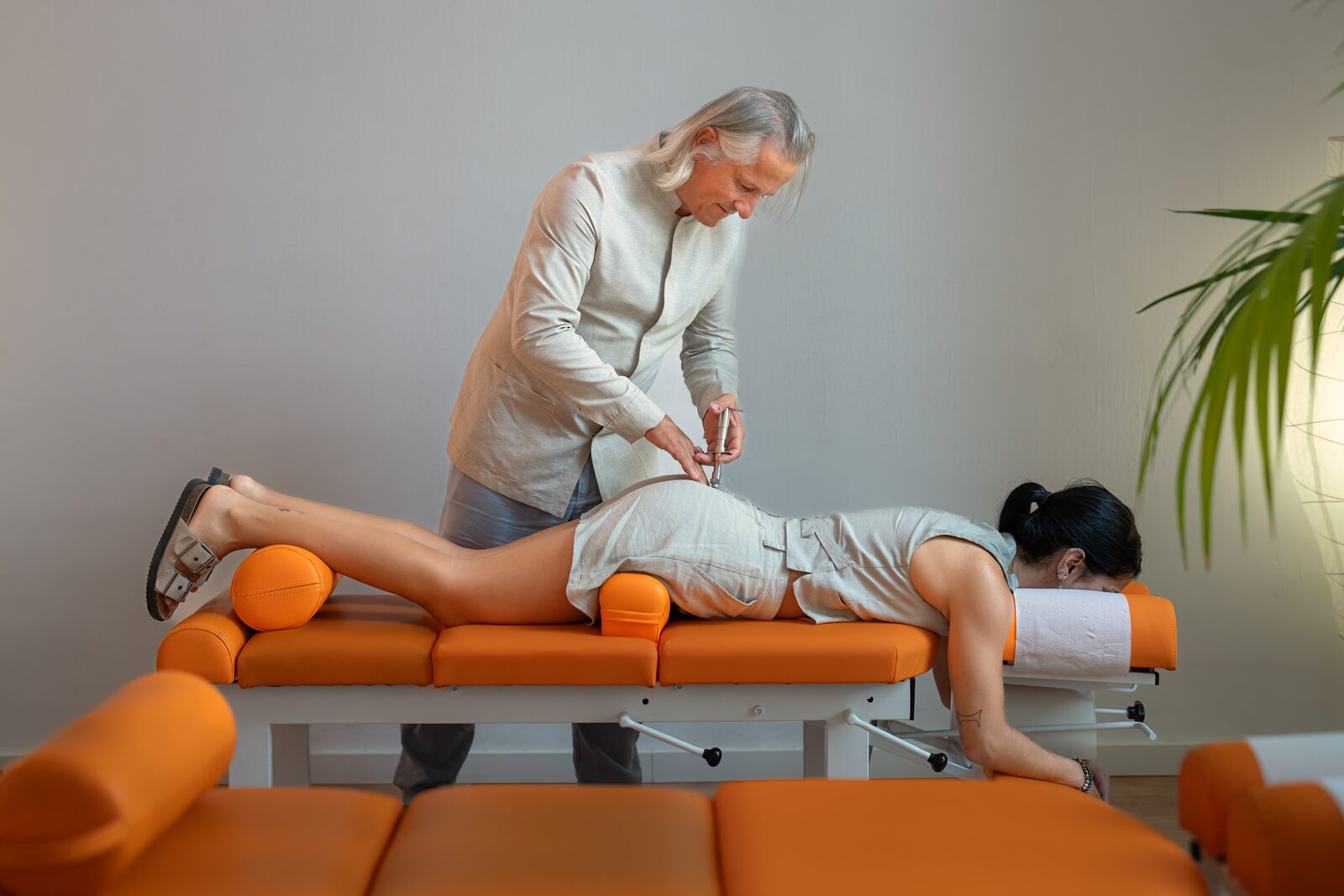
Low back pain is one of the most common reasons people look for a chiropractor, and a holiday, a long flight or a move abroad is often when it flares up. This page explains, in English, what we look at in our clinic in central Málaga, what you can expect, and when what you need is a doctor instead.
What low back pain usually is
Low back pain is any pain between the lower ribs and the buttocks. In the vast majority of cases there is no serious injury behind it: it is mechanical pain from muscles, joints and discs that have not coped well with a posture, an effort or long hours sitting still.
It is usually described by how long it has lasted. Acute low back pain has been there for less than six weeks and tends to improve. Chronic pain has lasted more than three months, and then it is worth understanding what keeps it going, which is rarely just one thing.
Something that surprises many people: wear and tear or a disc bulge on a scan does not explain the pain on its own. Plenty of people with no pain at all show the same findings on an MRI. That is why a scan is read together with the examination and your history, never on its own.
When it tends to start
We see two typical patterns. It starts suddenly: bending down to pick up a suitcase, lifting a child out of a car seat, a twist on the golf course or the padel court. Or it builds up: days of sightseeing on hard pavements, a long flight, a soft hotel mattress, hours at a laptop in a holiday rental.
What we hear most often: it is hard to get out of bed or up from a chair, the back «catches» when you bend, it aches by the end of the day, and sometimes the pain spreads into the buttock. If it runs down the leg, it may be more than low back pain.
What we do not do here
We do not diagnose or treat disease. If there is a medical cause behind the pain, it belongs to your doctor.
We do not change your medication. That decision is your doctor’s.
We do not replace a medical check after a hard fall. After a significant fall, the first step is to rule out a fracture at A&E (Urgencias).
What we do look at
- Mechanical low back pain, sudden or recurring, when getting up, after sitting for a long time or after an effort.
- Locking and stiffness when bending, turning or straightening up.
- Persistent muscle tension in the lower back and buttocks.
- Tailbone pain after a fall, once anything urgent has been ruled out.
- Low back pain with a diagnosed disc herniation.
- Repeated episodes, and getting back to sport as far as movement and posture are concerned.
Day to day: sleeping, sitting and travelling
Moving usually works better than staying in bed. Short walks, within what the pain allows, help more than long rest.
For sleeping, lie on your side with a pillow between your knees, or on your back with one under them. To get up, roll onto your side first and push up with your arms.
On a flight or a long drive, get up or stop every hour or so, and keep your lower back supported. Lifting luggage: hold it close, bend your knees, and turn with your feet rather than twisting with the weight in your hands.
None of this replaces what your own doctor has told you.
When to see a doctor, not us
See a doctor or go to A&E if your low back pain:
- Started after a hard knock or a fall, especially if you have osteoporosis.
- Wakes you at night or does not ease in any position.
- Comes with fever, unexplained weight loss or feeling generally unwell.
- Comes with weakness in a leg, numbness in the saddle area, or any change in bladder or bowel control.
How the first visit works
You will see José De San Juan Guerrero, D.C., Doctor of Chiropractic (Sherman College, South Carolina) and a registered physiotherapist in Spain, with more than 25 years in practice in central Málaga. The whole visit can be in English.
It takes about half an hour, always in the same order: we listen first, how it started, what makes it worse and what you have been told before; then come the physical examination and a computerised postural analysis; then we explain what we found before anyone touches you. If your case is suitable, the first adjustment is done that same day. Bring any X-rays or scans, even if the reports are in Spanish.
Why come, even if someone has already looked at your back
With low back pain it is easy to end up in a loop: painkillers, a few better days, and back to square one with the next effort. Your doctor is right to rule out anything serious first. What often gets left out is why your back locks every time you bend.
That part is ours. What we work on is movement: getting the joints of the lower back and pelvis that have stiffened to move again, and letting the muscles that have been guarding them for weeks stop doing so. That does not heal any disease, and we will not sell it to you as if it did. But moving with less pain changes your day: getting out of bed without thinking about it, tying your shoes, carrying your bag through the airport.
If at the first visit we see that you need something else, more tests, another specialist, or a return to the doctor, we will tell you that same day. We would rather tell you than let you waste time and money. And that is exactly why you can trust what we do tell you.
Frequently asked questions
Do I need a scan before coming?
No. If you already have one, bring it; if not, the assessment shows whether it is worth asking a doctor for one.
Can I come in the middle of a flare-up?
Yes, as long as none of the warning signs above apply. If you are unsure, call or send a WhatsApp and we will talk it through.
I am only in Málaga for a short time. Is it worth coming?
Yes, if the pain is limiting you now. At the first visit we will be clear about what can reasonably be done in the time you have here.
Book your first visit · Chiropractor in central Málaga, in English · C/ Córdoba 6 · +34 629 245 594 · WhatsApp
Esta página también está disponible en español: Lumbalgia en Málaga.
This clinic works on musculoskeletal complaints of the spine and joints. We do not diagnose or treat systemic, respiratory, autoimmune, metabolic or neurological disease, and we do not replace prescribed medical treatment. If you have a diagnosis of that kind, your specialist is the one who manages it.
Reviewed by José De San Juan Guerrero, Doctor of Chiropractic (Sherman College of Chiropractic, USA) and registered physiotherapist (Andalusia, no. 5960). Last reviewed: .
References
- World Health Organization. WHO guideline for non-surgical management of chronic primary low back pain in adults in primary and community care settings. 2023. OMS
- Qaseem A, et al. Noninvasive Treatments for Acute, Subacute, and Chronic Low Back Pain: A Clinical Practice Guideline From the American College of Physicians. Annals of Internal Medicine. 2017. PubMed
- Stochkendahl MJ, et al. National Clinical Guidelines for non-surgical treatment of patients with recent onset low back pain or lumbar radiculopathy. European Spine Journal. 2018. PubMed
- Rubinstein SM, et al. Benefits and harms of spinal manipulative therapy for the treatment of chronic low back pain: systematic review and meta-analysis of randomised controlled trials. BMJ. 2019. PubMed
- Paige NM, et al. Association of Spinal Manipulative Therapy With Clinical Benefit and Harm for Acute Low Back Pain: Systematic Review and Meta-analysis. JAMA. 2017. PubMed