
Pregnancy changes your posture, your weight and how loose your ligaments are, all within a few months, and your back feels it. That part, the low back and pelvic pain of pregnancy, is what we look at here, in English. The pregnancy itself belongs to your midwife and your obstetrician.
Why your back hurts in pregnancy
From the second trimester your centre of gravity moves forward, the curve of your lower back deepens and the pelvis loosens its ligaments to get ready for birth. That is normal physiology, not an illness, but it explains low back pain, pain deep in the buttock, or discomfort when you turn over in bed.
It is common and does not mean something is wrong. It also tends to ease after the birth.
What women often notice
Every pregnancy is different, but some things come up again and again. An ache low in the back that gets worse by the end of the day or after standing for a while. A sharp pain in one buttock or in the groin when you climb stairs, get out of the car or roll over in bed. Tension between the shoulder blades and in the neck as your posture changes.
After the birth there is something else: long hours sitting to feed, shoulders rounded forward, and a back that is tired from lifting the baby.
What we look at
- Low back pain in the second and third trimester.
- Pelvic and sacroiliac pain, the kind that appears when walking or climbing stairs.
- Neck and upper back pain from the change in posture and, later, from hours of feeding.
- Trouble sleeping because you cannot get comfortable.
- Back pain after the birth.
How the visit is adapted
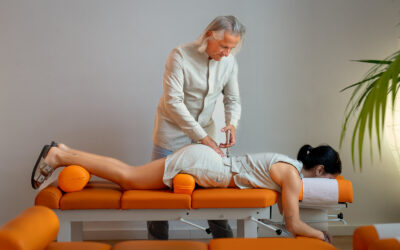
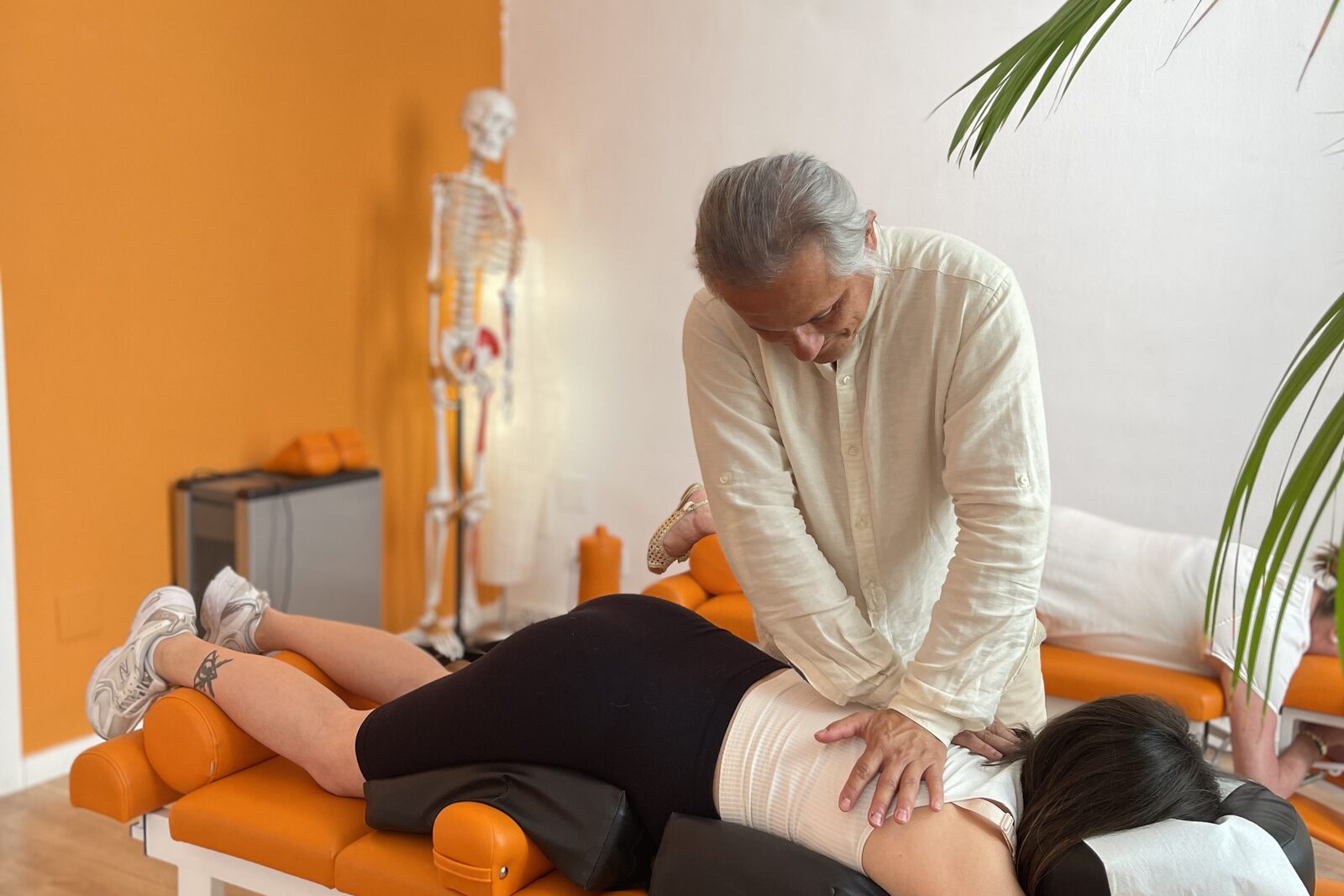
During pregnancy the session changes. You lie on your side, or face down on a table with supports that leave a space for your bump, with no pressure on it. The position is chosen according to how far along you are and how you feel. Techniques are chosen to be gentle and adjusted to you, and if a position is uncomfortable it changes there and then. You set the pace, and you can stop at any time.
How the first visit works
You will see José De San Juan Guerrero, D.C., Doctor of Chiropractic, graduate of Sherman College, USA, and a registered physiotherapist in Spain, with more than 25 years in practice in central Málaga. The whole visit can be in English.
We start by listening: how many weeks you are, how the pregnancy is going, anything you have been told at your check-ups and exactly where it hurts. Then comes an adapted examination, and an explanation of what we found before starting any treatment. If you have reports or instructions from your check-ups, bring them, even if they are in Spanish or another language. If yours is a high-risk pregnancy, or you have been told to take any precaution, tell us: we will look at it with you and, if now is not the time, we will say so.
What do the studies say?
Chiropractic adjustments and osteopathic treatment have been studied during pregnancy and after the birth. A 2017 review of osteopathic treatment found less low back pain and better function, with moderate-quality evidence in pregnancy and low-quality evidence after the birth. A 2020 review focused on chiropractic care found favourable but inconclusive results for low back pain in pregnancy. A trial of 400 women in the third trimester found better pain and function with osteopathic treatment than with usual care alone, but not compared with a sham treatment; another, on one-sided pelvic pain, found no difference from usual care. On safety, the authors of the latest review conclude that there is limited evidence of adverse events, that such injuries may be rare and that they need better reporting. The references are at the end of this page.
Why come, when your midwife is already looking after you?
If you are pregnant away from home, a lot is already being checked: blood tests, scans, blood pressure, the baby’s growth, often in a language that is not yours. What can fall through the gaps is not being able to turn over in bed without a sharp pain in your groin, buttock or lower back, or reaching the evening with a back that has had enough.
That part is ours. What we work on is movement: helping the lower back and pelvis move with less strain, and easing the muscles that are holding up the change in posture. It changes nothing about the pregnancy or the birth, and we will not sell it to you as if it did. But moving with less pain changes your days: sleeping a little better, managing the stairs at home, getting to the end of the working day.
If at the first visit we see you need something else, we will tell you that same day, and tell you where to go. We would rather tell you than let you waste time and money. And that is exactly why you can trust what we do tell you.
Day to day
For sleeping, lying on your side usually works better, with a pillow between your knees and another under your bump once it gets heavier.
For getting out of bed, roll onto your side first with your knees together and push up with your arms rather than sitting straight up.
For standing and walking, change position often and wear comfortable, stable shoes.
None of this replaces what your midwife tells you.
What we do not do here
We do not manage your pregnancy. That belongs to your midwife and your obstetrician, and their check-ups are not replaced or spaced out because you come here.
We do not promise to change the due date or how the birth will go.
We do not treat nausea, high blood pressure, gestational diabetes or any other condition of pregnancy.
When to call your midwife or go to hospital, not to us
Call your midwife or go to the hospital emergency department (Urgencias) if you have bleeding, leaking fluid, contractions before your time, a fever, a strong pain that comes on suddenly or feels different from what you have had so far, or if the baby is moving less than usual.
Frequently asked questions
Which trimester can I come in?
Any of them. You can also come before you get pregnant, for your back, and after the birth. At every stage what we aim for is easier movement in your joints, and the position and technique are adapted to how far along you are. This is not a fertility treatment.
Do I need permission from my midwife or obstetrician?
No. You can book directly. If you have been advised to rest or take any precaution, tell us at the first visit and we will take it into account. And if we see that now is not the time, we will say so.
How will I be positioned on the table?
On a table with supports that leave a space for your bump, so you can lie face down without pressure on it, or on your side if that is more comfortable. We will work it out together at the visit.
I am only in Málaga for a while. Is it worth it?
If the pain is limiting you now, yes. At the first visit we will be clear about what makes sense in the time you have here.
Book your first visit · Chiropractor in central Málaga, in English · C/ Córdoba 6 · +34 629 245 594 · WhatsApp
Esta página también está disponible en español: Dolor de espalda en el embarazo en Málaga.
This clinic works on musculoskeletal complaints of the spine and joints. We do not diagnose or treat systemic, respiratory, autoimmune, metabolic or neurological disease, and we do not replace prescribed medical treatment. If you have a diagnosis of that kind, your specialist is the one who manages it.
Reviewed by José De San Juan Guerrero, Doctor of Chiropractic, graduate of Sherman College, USA, and registered physiotherapist (Andalusia, no. 5960). Last reviewed: .
References
- Liddle SD, Pennick V. Interventions for preventing and treating low-back and pelvic pain during pregnancy. Cochrane Database of Systematic Reviews. 2015. PubMed
- Vleeming A, et al. European guidelines for the diagnosis and treatment of pelvic girdle pain. European Spine Journal. 2008. PubMed
- Franke H, et al. Osteopathic manipulative treatment for low back and pelvic girdle pain during and after pregnancy: A systematic review and meta-analysis. Journal of Bodywork and Movement Therapies. 2017. PubMed
- Weis CA, et al. Chiropractic Care for Adults With Pregnancy-Related Low Back, Pelvic Girdle Pain, or Combination Pain: A Systematic Review. Journal of Manipulative and Physiological Therapeutics. 2020. PubMed
- Hensel KL, et al. Pregnancy Research on Osteopathic Manipulation Optimizing Treatment Effects: the PROMOTE study. American Journal of Obstetrics and Gynecology. 2015. PubMed
- Gausel AM, et al. Chiropractic management of dominating one-sided pelvic girdle pain in pregnant women; a randomized controlled trial. BMC Pregnancy and Childbirth. 2017. PubMed
- Weis CA, et al. Adverse events from spinal manipulations in the pregnant and postpartum periods: a systematic review and update. Journal of the Canadian Chiropractic Association. 2021. PubMed