

Sciatica is not a disease in itself. It is the name for pain that starts in the lower back and runs through the buttock and down the back of the leg, along the path of the sciatic nerve. What lies behind it varies a lot from person to person, so the first step here is not treatment but working out what is causing it. And all of it can be done in English.
Whom you will see
José De San Juan Guerrero, D.C., Doctor of Chiropractic (Sherman College of Chiropractic, South Carolina) and a registered physiotherapist in Spain, with more than 25 years in practice in central Málaga.
What sciatica is
The sciatic nerve leaves the lower spine and runs through the buttock down to the foot. When something irritates it where it exits, the pain does not stay in the back: you feel it along the leg. That is why «sciatica» describes a symptom, not a diagnosis. Behind it there may be a disc herniation or bulge, a narrowing of the spinal canal, a stiff joint or very tight muscles in the buttock.
What people usually notice
- Pain in one buttock or one leg, sometimes reaching the foot.
- Burning, tingling or cramping running down the leg, rather than a dull ache.
- Pain that gets worse when sitting for a long time or getting up from a chair.
- Pain when coughing, sneezing or straining.
- Lower back stiffness in the morning or when bending.
Many episodes of sciatica ease over a few weeks. When they do not, or when they keep coming back, it makes sense to have them assessed.
What we do not do here
We do not diagnose the cause from scans or order MRIs: that is your doctor’s decision. If you already have them, we read them alongside your history.
We do not issue sick notes or change your medication.
We do not replace a medical assessment when any of the warning signs below appear.
What we do look at
- Lower back and buttock pain that comes with sciatica.
- Stiffness in the lower spine and pelvis, which changes how load is shared.
- Buttock and hip muscles that have been guarding for weeks.
- Everyday posture and habits that keep the irritation going: how you sit, bend and drive.
Sitting, driving and sleeping with sciatica
When sitting, keep your back against the backrest and your feet flat, and get up for a few steps every half hour. Very soft chairs and low sofas usually make it worse.
When driving, bring the seat forward so your leg is not fully stretched, and take breaks on long journeys. A hire car on holiday is a common trigger: unfamiliar seat, long drives, no breaks. A wallet in your back pocket presses right on the buttock.
For sleeping, lie on your side with a pillow between your knees, or on your back with a cushion under them.
Staying active within what the pain allows generally helps more than bed rest. None of this replaces your doctor’s advice.
When to see a doctor, not us
Go to A&E (Urgencias) or your doctor straight away if you notice:
- Loss of bladder or bowel control.
- Numbness in the area you would sit on in a saddle.
- Weakness in the leg or foot that gets worse from one day to the next.
- Pain in both legs at once.
- Fever, unexplained weight loss or a history of cancer together with back pain.
How the first visit works
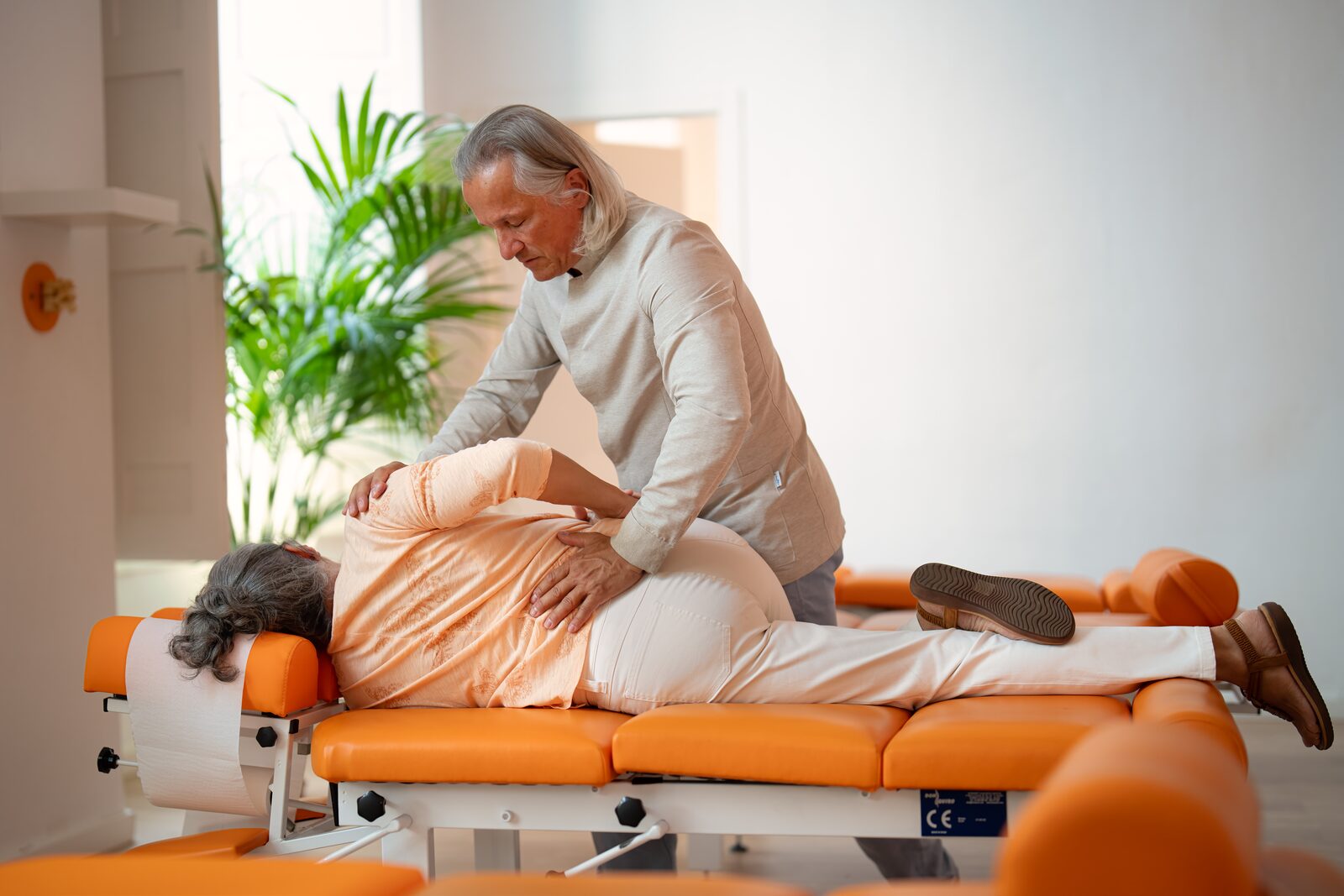
We start by listening: when it began, how far down the pain goes, what makes it better or worse, what you have been told and what you have tried. Then comes the physical examination and the postural analysis, and an explanation of what we found before anyone touches you. Bring any reports or scans, from home or from Spain, in whatever language.
Why come, even when another specialist is handling your sciatica
With sciatica it is easy to end up going from one appointment to the next: your GP, a specialist, a scan, a waiting list, perhaps in two countries. Meanwhile, the pain still decides how long you can sit.
That part is ours. What we work on is movement: getting a stiff lower back and pelvis moving again, and letting the buttock and hip stop compensating. That does not make a disc herniation disappear or replace your specialist’s decisions, and we will not sell it to you as if it did. But moving with less pain changes your day: sitting through a meeting, driving to work, sleeping without searching for a position all night.
If at the first visit we see that you need something else, more tests or a return to the doctor, we will tell you that same day. We would rather tell you than let you waste time and money. And that is exactly why you can trust what we do tell you.
Frequently asked questions
Do I need an MRI before coming?
No. If you have one, bring it. If the assessment shows you need one, we will tell you so your doctor can request it.
Can I come during a flare-up?
Yes, as long as none of the warning signs above are present. The assessment adapts to how much you can move that day.
Do I need a referral?
No.
I am only in Málaga for a short time. Is it worth coming?
Yes, if the pain is limiting you now. At the first visit we will be clear about what can reasonably be done in the time you have here.
Book your first visit · Chiropractor in central Málaga, in English · C/ Córdoba 6 · +34 629 245 594 · WhatsApp
Esta página también está disponible en español: Ciática en Málaga.
This clinic works on musculoskeletal complaints of the spine and joints. We do not diagnose or treat systemic, respiratory, autoimmune, metabolic or neurological disease, and we do not replace prescribed medical treatment. If you have a diagnosis of that kind, your specialist is the one who manages it.
Reviewed by José De San Juan Guerrero, Doctor of Chiropractic (Sherman College of Chiropractic, USA) and registered physiotherapist (Andalusia, no. 5960). Last reviewed: .
References
- Jensen RK, et al. Diagnosis and treatment of sciatica. BMJ. 2019. PubMed
- Stochkendahl MJ, et al. National Clinical Guidelines for non-surgical treatment of patients with recent onset low back pain or lumbar radiculopathy. European Spine Journal. 2018. PubMed
- Qaseem A, et al. Noninvasive Treatments for Acute, Subacute, and Chronic Low Back Pain: A Clinical Practice Guideline From the American College of Physicians. Annals of Internal Medicine. 2017. PubMed